Saturday, March 12, 2011

The Wise Thief!

There was a young thief busy stealing people’s wealth, one day a thought cross his mind he said to himself: “How far will I go with this petty stealing every now and then instead, why not travel to the king’s palace and steal the king. With that kind of money, I can then start my own business and lead a decent wealthy life”.

To accomplished his new thoughts, he started his journey to the king’s palace. On reaching the palace, in the darkness of the night he sneaked in to the palace and found himself in the majesty’s room. On hearing the sound of the footsteps, he hide himself behind the long drape’s.

While hiding he saw, it was the king and the queen walking to retire in their room. He overheard their conversation.

The Queen said, “Your majesty, have you ever thought about our only daughter?”

The King asked “what about her?”

The Queen replied “Don’t you think we need to find a Prince for our charming Princess.”

The King replied “Honey, you are absolutely right, by the grace of Allah (swt) we have everything excluding the heir and the next king for our kingdom hence we should find a pious humble Muslim youth from our kingdom, the one that will keep our daughter happy and be the next king after me. He shall continue the hard work of taking good care of our people”.

The queen nodding her head in agreement with the king said, “Then let us then find out that pious  Muslim youth”.

The king suggested, “Tomorrow, I will ask the Vazir to find out the most competent pious youth in our kingdom and you don’t reveal this plan to anyone”.

The thief hearing this conversation thought, if I steal tonight I may get a small part of his wealth instead if I could managed to play that crucial part of that pious youth that the majesty is looking for, I may end up becoming the next king along with the charming beautiful princess and so without stealing he quietly sneak out of the palace to accomplished his new plan, let us call it plan-B.

He went straight to the nearby Masjid and started his act of the pious young Muslim. Sure enough it worked, within a few days the town started to talk about this young Muslim youth dedicated to Islam. People started to come from far and wide to listen to this  eloquent speeches on the important tenets of Islam.

Then one day Vazir send his men to invite him to meet the king, but the young pious soul declined the king’s invitation saying that he was too busy in discharging the duties assigned to him by Allah (swt).

Hearing this, the king was further impressed, he said to his Vazir: “He is the true Muslim and our future Prince, let us go and visit him”.

Seeing the King along with his minister’s at his doorstep, tears rolled down the thief’s cheek, with so much gratitude in his heart he said to himself: “Just by acting as a pious Muslim, Allah has brought the mighty King to my door step, I wonder what would be the reward if I were to be REAL TRUE Muslim”. 

Now becoming the next king and marrying the princess had lost all its priorities. He apologized and declined the King’s offer saying “Now that I have found the REAL King of the universe who brought you to my doors, my rewards from now on will be from HIM.”

Friday, March 4, 2011

Reward of performing ablution like Amirul Momineen (a.s)

Imam Jafar as-Sadiq (a.s) says that one day Amirul Momineen (a.s) was sitting with Muhammad Ibne Hanafiyah. Amirul Momineen (a.s) said, "Muhammad, bring water for me to perform ablution for salaat." When Ibne Hanafiyyah brought the vessel containing water, he took water in his right hand and put it on his left hand reciting:
Bismillahi wa billahi wal hamdu lil lahil lazi ja'alal ma'a tahura wa lam yaj alhu najisa.

 Then washed that part place and recited:
Allaahumma h'as's'in farajee wa a-I'ffahu wastur a'uratee wa h'arrimnee a'lan naar.

Then he rinsed his mouth and recited:
Alla Humma laq qini hujjati yawma alqaka wa atliq lisani bizikrika.

Then he put water in his nose reciting:
Alla humma la tuharrim 'alaya rihal jannati waj 'alni mim man yashummu riha ha wa rawha ha wa tiba ha.

Then he washed his face and recited:
Alla humma bayyiz wajhi yawma taswaddufihil wujuh wala tusawwid waj hi yawma tabyazzul wujuh.

Then he washed his right hand reciting:
Alla humma a'tini kitabi bi yamini wal khulda fil jinani bi yasari wa hasibni hisaban yasira.

Then he washed his left hand reciting:
Alla humma la tutini kitabi bishimali wala min wara'i zahri wala taj alha maghlu latan ila unuqi wa a'uzu bika min muqat ta'atin niran

Then he performed Masah (wiping) on his head reciting:
Alla humma ghashshini bi rahmatika wa barakatika wa 'afwika.

Then performing Masah on his feet he recited:
Alla humma thabbitni alas sirati yawma tazillu fihil aqdam. Waj'al sa'yi fi ma yurzika 'anni ya zal jalali wal ikram.

Then he turned towards Muhammad Ibne Hanaffiyah and said "O Muhammad! One who performs ablution like me and recites these supplications, the Almighty Allah will create an angel for every drop of water used and these angels will continue to glorify Allah till the day of judgement and their reward will go to that person."

- Sawaabul A'amal

Thursday, March 3, 2011

The Shias of Ahlul Bayt (a.s.)

One of the traditions concerning the position of the Shias and the lovers of Ahlul Bayt (a.s.) states that the fire of Hell cannot scorch them. Thus, these types of traditions impart strength to our hope. Our love for the Ahlul Bayt (a.s.) is certainly a surety for us but it should not tempt us to commit sins blatantly. 

Shia and Mohib
The traditions regarding this subject are based on two important points. The first is concerned with 'Shia' and the second 'Mohibs' (Admirers) of the Holy Ahlul Bayt (a.s.). The position and status of those Shias who have achieved excellence in the field of knowledge and good deeds is definitely higher. Even so, such people did not consider themselves fit to be called the Shias of Ahlul Bayt (a.s.). Take the example of Muhammad bin Muslim Thaqafi. He was the honourable companion (Sahaabi) of Imam Muhammad Baqir (a.s.) and Imam Ja'far as-Sadiq (a.s.). Both the Holy Imams (a.s.) have recommended him to the Shias for solving their religious problems. Muhammad bin Muslim Thaqafi has also been mentioned as the greatest Jurist of his time in the books of Rijal (Chain of narrators).
On one occasion Muhammad bin Muslim along with Abu Karibatul Azdi went to see Qazi Shareek. Shareek glared at him in anger and said, "These two are Ja'fari and Fatimi!" [Shias of Ahlul Bayt (a.s.)]. Upon hearing this, both of them began to cry bitterly. When the Qazi enquired the reason for their lamentation, they replied, "You have associated us with such a lofty personality [Imam Ja'far as-Sadiq (a.s.)]!. Are people like us who lack in piety and abstinence to be compared with such an exalted person? What connection does the dust have with the Divine existence? (A Persian saying). We shall be highly obliged to you if you can accept our request (and give us not the title that we do not deserve)." 

The True Shias are Those Who Follow (Obey) the Imams (a.s.)
Yes, we can give the title of 'Shia' to that individual who follows the Imams (a.s.) in all aspects of character and speech. Thus, Bab-ul-Hawaij Imam Musa al-Kazim (a.s.) says:
"Our shias are only those who follow us (in every respect), walk in our footsteps and imitate our actions."
(Behaarul Anwaar) 

Conversation of Ali (a.s.) With Some Shias
On a certain evening Ali (a.s.) was departing from the mosque. The surroundings were bright due to the moonlight. He saw behind him a group of people walking towards him. He enquired as to who they were? They said: "We are your Shias." Ali (a.s.) looked at their faces carefully and said.
"Why is it that your faces do not exhibit any sign of you being a Shia?".
"Master, what are the signs of a Shia?"
"Their faces are pale due to excessive worship and the fear of Allah, their backs are bent due to prolonged prayers, too much fasting causes their abdomen to touch their backbones, their lips become dry be repeating endless invocations, and their hearts are filled with the fear of Allah."
(Behaarul Anwaar, Al-Irshad).
Now I shall quote three traditions for the benefit of the readers:

Mere Claim is not Sufficient
1) Jabir (a.r.) relates from Imam Ja'far as-Sadiq (a.s.) that he said,
"Is it sufficient for one to associate himself with Shiaism and say that, "I am a lover of Ahlul Bayt (a.s.)? By Allah, our Shia is not, but the one who fears Allah and obeys His Commands."
(Al-Kafi)
2) Imam Ja'far as-Sadiq (a.s.) told Mufazzal bin Umar,
"If you wish to see one of our devotees then look for that person who abstains from sins and fears more His Creator and remains hopeful of His reward. Whenever you find such an individual then take it for granted that he is one of my devotees."
3) Isa bin Abdulla Qummi entered in the presence of Imam Ja'far as-Sadiq (a.s.). The Imam said,
"That person is not from us nor do we hold him in esteem, the one who, if he lives in a town of a population of hundred thousand and there is even one non-Shia who is more pious than him."
(Al-Kafi).
Thus the belief, actions and the piety of the Shias of Ahlul Bayt (a.s.) should be such that they should be the best and none should excel them. Allah has defined such people 'Khairul Bareeya' in the Holy Qur'an:
"(As For) those who believe and do good, surely they are the best of men."
(Surah Bayyanah 98:7)
The Holy Prophet (s.a.w.s.) is reported to have explained that 'Khairul Bareeya' connotes the Shias of Ali (a.s.):
"O Ali, 'Khairul Bareeya' means you and your Shias. On the Day of Judgement, they would be satisfied with what Allah has bestowed upon them and they shall be liked by Allah. (Tafseer Tabarsi, Manaqib Khwaarazmi, Ibne Hajar). 

- Greater Sins, Vol.1

Sins Blacken the Heart

The first tradition is reported from Imam Ja'far as-Sadiq (a.s.): He said,
"There is no man who does not have a white spot in his heart. When he commits a sin a black spot emerges from this spot. If he repents, the blackness goes away but if he sinks in sin and continues to sin the blackness keeps on increasing till it surrounds the whiteness of the heart completely. When the white spot is totally covered by the blackness, the owner of this heart will never revert towards goodness. This tradition is in consonance with the utterance of Allah:
"By no means! But on their hearts is the stain of the (ill) which they do."
(Surah Mutaffefeen 83:14)

The Blackened Heart is Immune to Advice and Counsel
The people with the 'blackened heart' are totally unaffected by any counsel because their sins have caused the darkness to spread all over their heart. The loss of the inner eye prevents them from perceiving truths nor can they recognise the truth when they see it. They cannot accept any exhortation and revert to the path of virtue. It is in this connection that Imam Ja'far as-Sadiq (a.s.) explains:
"A man resolves to perform a sinful action but does not act upon it, but sometimes does commit it; Allah sees him and says: "By My Glory, after this I shall never forgive you."
According to another report, the person (sinner) is kept away from the Mercy of Allah due to his sin. He also does not get the impetus to seek repentance, hence his sin is never forgiven. Allama Majlisi (r.a.) writes in the explanatory note of the above tradition: "The purport of this tradition of Imam Ja'far as-Sadiq (a.s.) is that, the Imam has commanded us to fear all types of sins because every sin seems to be such that it may not qualify being overlooked. 

- Greater Sins, Vol.1

Excessive Sins Destroy the Faith (Belief)

Whatever has been mentioned in the discussion of intercession states that intercession comes to the rescue when the person concerned has died with correct belief. It happens, sometimes that, due to excessive involvement in sins and delay in repentance, faith in religion is erased from the heart. Subsequently he enters the limit of doubt and reaches the point of denial (Kufr). At this time if he is taken away by death, such a person is similar to the one who had consumed poison in the false hope that the doctor would save his life. But when the doctor arrives, death had already preceded him. What can the doctor do to cure him. In the same way the request of the intercessors is ineffective for the one who has died as an unbeliever.
"So the intercession of intercessors shall not avail them."
(Surah Muddassir 74:48)
In order to prove my statement I propose to quote one verse from the Holy Qur'an and two traditions:
"Then evil was the end of those who did evil, because they rejected the communications of Allah and used to mock them."
(Surah Rome 30:10) 


- Greater Sins, Vol.1 

Wednesday, March 2, 2011

Effect of Salwaat

Holy Prophet Muhammad al Mustafā (S.A.W.W) said:
to Amir al-Mu'minin Imām ‘Alī ibn Abī Tālib (A.S.) that-

"Jibrael informed me that a person from my nation who recites Salawaat on me and my progeny, then for him the doors of the skies are opened, angels recite Seventy salawat on him and if he is a sinner then his sins will fall like leave falls from the tree.

[Reference: Bihar al-Anwar, Vol 94 Page 55 Tradition 28]


14 Million Salawat Campaign in the blessed months of Rab'i 
(Rabi' al-awwal &  Rabī' al-Akhir)

Friday, February 25, 2011

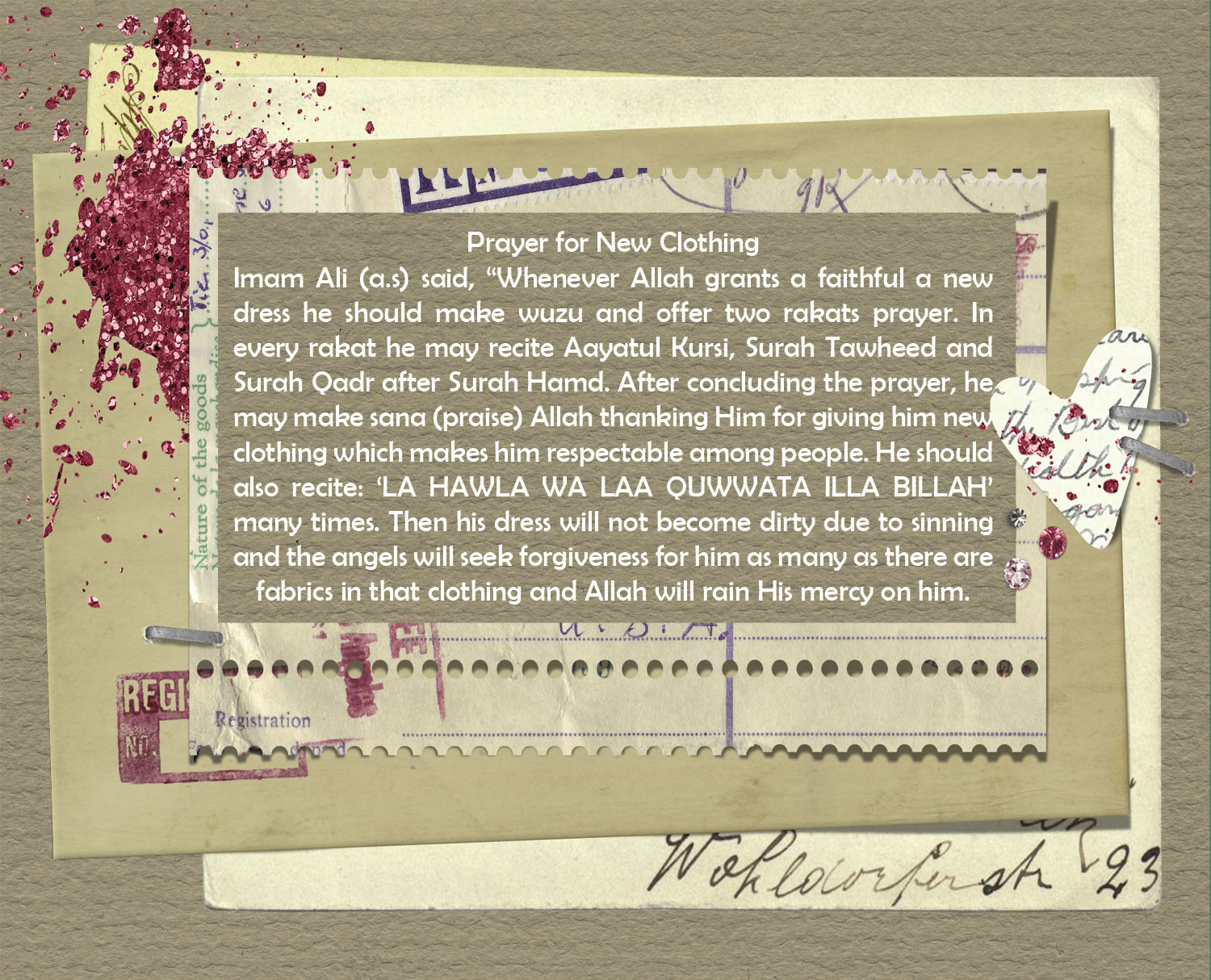
Dua at the time of making/wearing new garment


Changing Garments


Prayer for New Clothing


Reward of uttering a name of Allah while performing ablution

Imam Jafar as-Sadiq (a.s) says, "One who utters a name of Allah while performing ablution his whole body will become pure. All his sins between two ablutions will be wiped off. One who does not utter a name of Allah while performing ablution only the parts of body concerned with ablution will become pure and not his whole body."

Imam Jafar as-Sadiq (a.s) says, "A person who utters the name of Allah while performing ablution is like one who has performed a ghusl."

- Sawaabul Aa'amal


Thursday, February 24, 2011

I am Concerned About You Regarding Barzakh

Umar ibne Yazid says that, "I asked Imam Ja'far as-Sadiq (a.s.), "I have heard you saying that all our Shia's will enter Heaven however sinful they may be?" Imam replied,
"By Allah I had truly said, they shall all belong to Heaven."

Then I asked, "May my life be sacrificed upon you, even if their sins are great and in large number?" Imam said,
"All of you (Shias) shall enter Paradise by the intercession of the Holy Prophet (s.a.w.s.) or his successors on the Day of Judgement. But, by Allah I fear for you the Barzakh."
I asked,"What is Barzakh?"
He replied,
"Barzakh is the grave. Its duration commences from the time of death until the Day of Judgement."
(Al Kafi) 

- Greater Sins, Vol.1

Greater sins and smaller sins

Abstaining From the Greater Sins Cause the Lesser Sins to be Overlooked
If one avoids the Greater Sins, the Lesser sins shall be overlooked. Allah, the Almighty, by His grace, excuses the Lesser sins. As it is mentioned in the following verse of the Holy Qur'an
"If you shun the Greater Sins which you are forbidden, We will do away with your smaller sins and cause you to enter an honourable place of entering."
(Surah Nisa 4: 31)

The Gates of Paradise are Open for the Pious
The Holy Prophet (s.a.w.s.) is reported to have said,
"I swear by Allah, in Whose power is my life, there is not a single person who prays five times a day, fasts during the month of Ramadhan and abstains from sins that the gates of Paradise will not be opened for him."
After this he recited the Qur'anic verse quoted above.
(Tafseer Minhaajus Saadeqeen)

Intercession
A person who commits a Greater Sin and does not repent for it, is a transgressor. Namaz is not allowed behind him (he cannot lead a prayer assembly). His testimony is unacceptable. After death, he is liable for Divine punishment. By the Grace of Allah such a person may yet get salvation; and the Grace of Allah that can make this possible is the intercession of Muhammad (s.a.w.s.) and his Progeny (a.s.).
As the Holy Prophet (s.a.w.s.) says in one of his traditions:
"My intercession has been kept for the sinful among my followers."
(Behaarul Anwaar vol.3).
He (s.a.w.s.) also said,
"My intercession is specially for the sinful ones among my followers. But those who abstain from the Greater Sins, for them there is no accounting (of deeds)."
That is, they would be admitted to Paradise right away. 

Intercession Should not Prompt one to Commit Sins
There is hardly any doubt regarding the reality of Shafa'at (intercession). Actually it is the right bestowed upon the Holy Prophet (s.a.w.s.) and the purified Imams (a.s.), by Allah, to show their greatness and position. The other aim of intercession is to make their respect evident. The people who have committed Greater Sins shall be entrusted to them. By the grace of their intercession the sinful people will be able to ascend the heights like other groups of people. All this is evident from the Holy Qur'an and the authentic reports. It is also clear from Mutawatir (most frequently related) traditions. It would be needless to relate all such traditions for such a short discussion.
Only one point must be stressed at this stage. Intercession should not be taken as a license for committing sins nor should it make one heedless of repentance. 

Suicide in the Hope of Salvation
To sin and not to repent in the hope of intercession is akin to consuming poison or putting ones hand in the snake's mouth with the hope that a doctor would arrive and cure you. It is against logic, because after consuming poison it cannot be taken for granted that medical assistance would be available. Even if a doctor and medicines arrive on time it is still difficult to say that life would be saved. Before the medicine could have any effect the poison may spread to the whole body and death may occur.
In the same way, one who performs lewd actions in the hope that he would be interceded after death; cannot be sure that intercession will come to the rescue immediately. 

- Greater Sins, Vol.1

ZUHD AND PIETY

Another spiritual motif conspicuous in the teachings of the Nahj aI-baaghah is zuhd, which after taqwa is the most recurring theme of the book. Zuhd' means renunciation of the world', and very often we encounter denunciation of the world', and invitation and exhortation to renounce it. It appears to me that it forms one of the important themes of the Nahj aI-balàghah, which needs to be elucidated and explained in the light of various aspects of All's approach.


We shall begin our discussion with the word 'zuhd'. The words zuhd' and raghbah' (attraction, desire), if mentioned without reference to their objects, are opposite to each other. Zuhd' means indifference and avoidance, and raghbah' means attraction, inclination, and desire.
Indifference can be of two kinds: involuntary and cultivated. A person is involuntarily indifferent towards a certain thing when by nature he does not have any desire for it, as in the case of a sick person who shows no desire either for food, or fruits, or anything else. Obviously, this kind of indifference and abstinence has nothing to do with the particular sense implied in zuhd'.
Another kind of indifference or abstinence is spiritual or intellectual; that is; things that are natural objects of desire are not considered the goal and objective by a human being in the course of his struggle for perfection and felicity. The ultimate objective and goal may be something above mundane aims and sensual pleasures; either it may be to attain the sensuous pleasures of the Hereafter, or it may not belong to this kind of things. It may be some high ethical and moral ideal, like honour, dignity, nobility, liberty, or it may belong to the spiritual sphere, like the remembrance of God, the love of God, and the desire to acquire nearness to Him.

Accordingly the zahid (i.e. one who practises zuhd) is someone whose interest transcends the sphere of material existence, and whose object of aspiration lies beyond the kind of things we have mentioned above. The indifference of a zahid originates in the sphere of his ideas, ideals, and hopes, not in his physiological makeup.

There are two places where we come across the definition of zuhd' in the Nahj aI-balaghah. Both of them confirm the above interpretation of zuhd. Ali (a.s), in khutbah 81, says:
O people! zuhd means curtailing of hopes, thanking God for His blessings and bounties, and abstaining from that which He has forbidden.
In hikmah 439, he says:
All zuhd is summarized in two sentences of the Qur'an: God, the Most Exalted, says, ...So that you may not grieve for what escapes you, nor rejoice in what has come to you.' [57:23] Whoever does not grieve over what he has lost and does not rejoice over what comes to him has acquired zuhd in both of its aspects.

Obviously when something does not occupy a significant position amongst one's objectives and ideals, or rather is not at all significant in the scheme of things which matter to him, its gain and loss do not make the slightest difference to him.
However, there are some points that need clarification. Is zuhd, or detachment from the world, on which the Nahj aI-balaghah, following the Qur'anic teachings, puts so much emphasis, to be taken solely in an ethical and spiritual sense? In other words, is zuhd purely a spiritual state, or does it possess practical implications also?
That is, is zuhd spiritual abstinence only or is it accompanied by an abstinence in practical life also? Assuming that zuhd is to be applied in practice, is it limited to abstinence from unlawful things (muharramat), as pointed out in khutbah 81, or does it include something more, as exemplified by the life of Ali (a.s) and before him by the life of the Holy Prophet (s.a.w)?
Proceeding on the assumption that zuhd is not limited to muharramat only and that it covers permissible things (mubahat) as well, one may ask: what is its underlying rationale and philosophy? What is the use of an ascetic life that limits and confines life, rejecting its blessings and bounties? Is zuhd to be practised at all times or only under certain particular conditions? Is zuhd--in the sense of abstinence from even permissible things-basically in agreement with other Islamic teachings?
Apart from this, the basis of zuhd and renunciation of the world is the pursuit of supra-material objectives and ideals. What are they from the point of view of Islam? In particular, how does the Nahj al-balaghah describe them?

All these questions regarding zuhd, renunciation, and curtailing of hopes----themes which have so often been discussed in the Nahj al-balaghah----need to be clarified. We shall discuss these questions in the following pages and try to answer them.
Glimpses of the Nahj a1-Ba1aghah, by Shaheed Murtadha Mutahhari.

New Domes on the Holy Shrines of Kadhimayn (a.s)

New Domes on the Holy Shrines of Kadhimayn (a.s) + PICReplacement operations of the golden dome and minaret of the holly shrine of Imam Musa ibn Jafar (a.s) in Kadhimayn city of Iraq finished. The celebration held on September 14 with the presence of Iraqi authorities and the manager of the shrine.

        The area of the dome of the holly shrine of Imam Musa ibn Jafar (a.s) is 335 square meters. The constructors used 10 thousand and 261 golden bricks for the dome and 1416 golden brick for the three minarets.

    The reconstruction and replacement of the holly shrine completed in one and a half years.


Those A'mal which Prove helpful to pass over the poole serat easily

  1. Sayyed ibne Tawoos in his book Iqbal relates that whoever recites twenty units (Rak'at) of prayers after Namaze Maghrib on the night of the first of Rajab, such that in each Rak'at after Surab-al -Hamd recites once Surah-al-Tawheed, then he and his family will be saved from the punishment in the grave, and will cross the poole Serat like lightening without any accounting. 
  2. It is related that whoever fasts for six days in the month of Rajab will find peace in Qayamat, and will walk over the poole serat easily without been accounted. 
  3. It is related that a person who recites ten units of Namaz on the night of twenty ninth Sha'ban, such that in each unit after Surah-al-Hamd recites ten times Surah-at-Takasur, Surah-an-Naas, Surah-al -Falaq, Surah-al-kaferoon, and Surah-at-Tawheed each, Allah will give him reward equal to theologians, and will increase his good deeds, will ease his accounting, and he will cross the poole Serat like lightening.  
  4. As discussed in the earlier chapter, that whoever goes for pilgrimage to the shrine of Imam Ali-ar-Reza (A.S.), Imam (A.S.) Himself comes for his rescue (in Qayamat) at three different places and saves him from the terrors of that day one of which is the Bridge of Serat’.
Ref: Manazelul Akherah

The Bodies were intact even after more than 1000 years

Though in normal cases and circumstances the dead bodies in the grave decompose and disintegrate yet there are proofs where the dead bodies of martyrs, prophets and saints have been found intact when their graves were dug.

In 1932 A.D. (1351 A.H.) the then ruling King of Iraq Shah Faisal I, dreamt that he was being addressed by Hudhaifa al-Yamani, who said :-

"O king ! Remove Jabir ibn Abdullah Ansari and me from the bank of river Tigris and bury us at some safe place because my grave is already water-logged, (full of water) while Jabir's grave is slowly getting water-logged."

This dream was repeated again the next night, but King Faisal did not pay attention to it on account of his pre-occupation with state affairs. On the third night Hazrat Hudhaifa was seen in the dream by the grand Mufti of Iraq.

Hazrat Hudhaifa said to the grand Mufti: "I have been directing the king since two nights to transfer our Bodies but he has not paid any heed. Tell him emphatically to arrange for the transfer of our graves!"

So after discussing this matter, the King, his Prime Minister and the Grand Mufti decided to carry out this work. It was decided that the Grand Mufti should issue a fatwa (religious ruling) on this matter and the Prime Minister will issue the fatwa to the press, so that the public may know about this great event. It was declared that on 10th Zilhajj after noon prayers the graves shall be opened and the holy bodies shall be transferred to another place.

As it was Hajj season, pilgrims had gathered in Mecca. They requested King Faisal to postpone the event for a few days so that they all could attend the event after performing the Hajj. Hence, the King postponed this event to 20th Zilhajj.

After noon prayers, on 20th Zilhajj 1351 A.H. a large number of Muslims and non-Muslims gathered in Baghdad, and the city was heavily crowded. First when the grave of Hazrat Hudhaifa was opened water was found inside. The body was lifted with a crane in such a way that it safely came on a stretcher. Then the stretcher was lifted by the King, the Grand Mufti, the Prime Minister and Prince Farooq of Egypt and brought to a glass coffin box made especially to keep the holy bodies. The body of Hazrat Jabir was also transferred to the glass box in the same scrupulous manner.

The most marvelous spectacle was now seen by the huge crowd that had gathered to witness this great event. Both the holy bodies of these true companions of the Holy Prophet (SAWW) were fresh and intact while their open eyes issued forth such divine light that the spectator's eyes were dazzled. Furthermore, their coffin, clothes, kaffan were also intact and at first glance, it appeared as if these heroes of Islam were alive. The two bodies were then taken away and buried afresh near the grave of another great hero of Islam, Salman-e-Farsi, in Salman Park which is 30 miles from Baghdad. This miracle amazed the scientists, philosophers and doctors. They were all bewildered and spellbound to witness this great miracle.

A German physiologist who had been showing a lot of interest in this was so impressed by the conditions of the bodies, which were buried for more than a thousand years, that he immediately came to the Grand Mufti, held up his hands and said, "What more evidence can there be in support of Islam. I embrace Islam so teach me about it!"

Thus before thousands of people this German doctor became a Muslim. His example was followed by many Christians and Jews and for a long time it continued in Baghdad and a large number of people became Muslims as a result of this miracle.

Now let us all sit-back and think over this event and derive a lesson from this miracle. Pondering over such events is potent food for the mind and serves as an eye-opener to humanity. Some of the material above was published in a Pakistani newspaper, "Daily Jung" on 7th June 1970.

Let us now briefly look into the lives of these prominent personalities.

HAZRAT HUDHAIFA AL YAMANI

He was one of the most trusted companions of the Holy Prophet (SAWW) and a near associate of Hazrat Imam Ali (AS). He was one of those seven persons who joined the funeral prayers of Bibi Fatemah (AS). There are several instances in history where Hazrat Hudhaifa has proved steadfast in his loyalty to our Holy Prophet (SAWW). Hazrat Hudhaifa had responded to the Prophet's call in battle of Trench (Khandak) when the Prophet had promised Paradise to the person who would venture out to the enemy's camp with the intention of spying their activities.

Hazrat Hudhaifa was known as "the possessor of the Secret", since the Holy Prophet (SAWW) had revealed to him the names and specific identity of those hypocrites who intended to kill him on his return journey from Tabuk, but had strictly instructed him not to disclose the secret.

Hudhaifa was appointed governor of Madain (which is a place near Baghdad, Iraq) by Caliph Omar and held that post for many years. He was holding that post till Hazrat Imam Ali (AS) assumed the caliphate. Hazrat Imam Ali (AS) then sent a letter to the people of Madain, informing them of his caliphate and that Hudhaifa would continue to be the governor of Madian. Hudhaifa al Yamani died just before the battle of Jamal in 36 A.H. He was buried in Madain.

HAZRAT JABIR IBNE ABDULLAH-E-ANSARI

Jabir-e-Ansari was also one of the most exalted companions of the Holy Prophet (SAW). Jabir was in the forefront in 18 battles, under the banner of Islam. Jabir was blessed enough to have met all the imams up to Imam Mohamed Baker (as) in his lifetime. Imam Jafar-e-Sadiq (AS) has said : "Jabir -e-Ansari was the last survivor amongst the companions of the Holy Prophets (SAWW).

Jabir, on hearing about the martyrdom of Imam Hussain (AS) and his companions and the imprisonment and humiliation of the surviving members of his family, hastened towards Kerbala with his devoted friends and followers and buried the martyrs there. He was the first person to pay homage to the martyrs of Kerbala and carry out their burial rites.

The Holy Prophet (SAW) once told Jabir that, he would live long enough to come across a person whose name would be Mohamed Baker (as) and he will resemble the Holy Prophet in appearance and values. The Holy Prophet asked Jabir to convey his salaams to this man. Throughout his life Jabir was waiting eagerly to meet our Imam. Finally, when Jabir did meet the Holy Imam he was very old but very happy and he conveyed the prophet's salaam to the Imam. Jabir did not live long after that. He was tortured by Hajjaj bin Yusuf and it is reported that molten lead was poured on the hands of Jabir by the tyrant. Jabir-e-Ansari was 94 years old when he left this world for the heavenly abode in 78 A.H. He was also buried in Madain.

Thus let us send our gift of Sure-Fateha for these two brilliant graduates from the school of Prophet hood, who devoted all their efforts in safeguarding our religion. Let us not forget their invaluable contribution to keep the flame of Islam kindled in our hearts. And pray to The Almighty Allah to help us follow their footsteps and elevate our level of imaan. 

Saturday, February 19, 2011

When will Deliverance Take Place?

It has been narrated by Jabir Jaufi that: I asked Imam Muhammad Baqir (as) about Imam Mehdi (as)’s reappearance that when will ‘Faraj’ deliverance take place?

Our fifth Holy Imam (as) replied: “Alas! Alas! There shall be no Faraj until you all become a mesh (he repeated the sentence three times), the impure believers are exterminated and only the pure believers remain!”
 

Almighty Allah (s.w.t) says in the Holy Quran: “Do men think they will be left alone on saying – we believe; and not be tried?”

Sheikh Saduq (May Allah elevate his position) has recorded this event in the book – ‘Kamaluddin’ from Sadir Sairafi who was bestowed with the honor of visiting our 6th Imam (as) along with Mufazzal bin Umeir and Abu Baseer.

We asked the son of the Messenger of Allah about Qaem (as). Imam Jaffer Sadiq (as) replied: “The characteristics Allah assigned for his Prophets have been assigned for our Qaem (as) too. Just as Prophet Isa (as) went away into occultation from his people, similarly Allah Almighty has ordained that our Qaem (as) shall also go away into occultation from his people. His occultation shall be lengthy such that the deviators shall deny him.

The delay of our Qaem (as) is like the delay of Prophet Nuh (as). Nuh (as) had asked Allah to punish the disbelievers and requested salvation for the believers.

Allah informed Nuh (as): “Plant these seeds because you will attain salvation and deliverance after they become trees and bear fruit. Give glad tidings about this matter to your followers.” Prophet Nuh (as)  followed the orders of Almighty Allah.

When after a long time the seeds turned into strong trees possessing branches, leaves and dates; Prophet Nuh (as) asked Allah to fulfill his promise.

For the second time Allah ordered Nuh (as) to sow fresh date seeds yet again. Allah ordered Nuh (as) to adopt patience and inform his believers. When Prophet Nuh (as) informed his people - three hundred of his believers turned apostates; doubting the Prophet Hood of Nuh (as) and Allah’s promise.
 

Once again the seeds turned into strong trees bearing dates Prophet Nuh (as) asked Allah for deliverance. And yet for the third time Nuh (as) was ordered to follow the same instructions as before; and on informing his followers a greater number of his believers turned away from him. They turned away from Allah’s representative and Allah’s promise.

Now the number of Nuh (as)’s true believers remained seventy in number. And here Allah revealed to Nuh (as): “The brightness of dawn has obviated the darkness of night since truth has been established and faith has been purified. My promise was salvation and deliverance for the believers. I was aware of the shaky faith and evil nature of those among your followers who later turned apostates. Now by our command, you may start building the ship; for those who remain are the ones whose monotheistic belief is based on sincerity and they have clung to the rope of your Prophet Hood. My promise is to make them vicegerents over the earth, give strength to their religion and turn their fears into tranquility.”

Imam Sadiq (as) said: “The same condition shall prevail for our Qaem (as). The period of occultation will be a long one until absolute truth appears and faith gets clearly distinguished from the evils of discord; so that any of the Shia who are evil in nature and have feelings of discord will exit from religion. “

These are the ones about whom our Masumin (as) have foretold that faith shall depart from them just as a knife slices easily through butter.

Conclusion

Al Imam Mahdi (as) is the Imam through whose obedience we should be upright. Imam e Zamana (as)  is the channel between us and Allah. The Holy Prophet (s.a.w.w) repeatedly emphasized to hold on to the Holy Quran and the Holy Ahlul Bayt (as). Holding on to them does not mean we have to catch hold of their hands; rather it means we have to act upon their sayings and follow their path. This is feasible and possible for each and every person. Therefore there cannot remain any excuse and none can say: “The Twelfth Imam (as) was hidden so we could not hold on to him.”

It is not obligatory on Imam (as) to approach us; rather it is obligatory upon us to approach His Excellency. And the best way to do this is by sincerely following the commands of Allah and Ahlul Bayt (as); protecting the Ahlul Bayt (as); warding off their enemies; increasing our love for the Masumin (as) and deeply hating their enemies.

Quran and Ahlul-Bayt

Based on a parallel (Mutawatir) tradition upon whose authenticity all Muslims agree, the Messenger of Allah (AS) informed his followers in several occasions that he would leave them two precious/weighty things and that if Muslims adhere to both of them, they will never go astray after him. They are
the Book of Allah (Quran) and the Members of the House of the Prophet (Ahlul-Bayt), peace be upon them all.

It is narrated in Sahih Muslim as well as many other sources that:

Someday (after his last pilgrimage) the Messenger of Allah (PBUH&HF) stood to give us a speech beside a pond which is known as Khum (Ghadir  Khum) which is located between Mecca and Medina. Then he praised Allah and reminded Him, and then said: "O' people! Behold! It seems the time
approached when I shall be called away (by Allah) and I shall answer that call. Behold! I am leaving for you two precious things. First of them is the book of Allah in which there is light and guidance... The other one is my Ahlul-Bayt. I remind you in the name of Allah about my Ahlul-Bayt. I remind you in the name of Allah about my Ahlul-Bayt. I remind you in the name of Allah about my Ahlul-Bayt. (three times)."

Sunni Reference:
- Sahih Muslim, Chapter of the virtues of the companions, section of the virtues of Ali, 1980 Edition Pub. in Saudi Arabia, Arabic version, v4, p1873, Tradition #36.
- And many others such as Sahih al-Tirmidhi, Musnad Ahmad (see below).

For the English version of Sahih Muslim, see Chapter CMXCVI, v4, p1286, Tradition #5920

Despite the fact that the author of Sahih Muslim and many other Sunni traditionists have recorded the above tradition in their authentic books, it is regrettable that the majority of Sunnis are unaware of its existence at the best, or deny it at the worst. Their counter argument is that the most reliable tradition in this regard is the one recorded by al-Hakim in his al-Mustadrak, on the authority of Abu Huraira, attributing to the Messenger of Allah saying: "I leave amongst you two things that if you follow or act upon, you will not go astray after me: The Book of God and my Sunnah (traditions)."

There is no doubt that ALL Muslims are required to follow the Sunnah of the Prophet (PBUH&HF). However, the question remains that which Sunnah is genuine and which one is invented later and was falsely attributed to the Prophet.

On tracing the source of this report of Abu Huraira which states "Quran and Sunnah," we found out that it has NOT been recorded in any of the six authentic Sunni collections of the traditions (Sihah Sittah). Not only that, but also al-Bukhari, al-Nisa'i, and al-Dhahabi and many others rated this
report (Quran and Sunnah) as weak because of its weak Isnad. It should be noted that although the book of al-Hakim is an important Sunni collection of traditions, yet it is ranked inferior to the six major Sunni books. This is while Sahih Muslim is in the second rank among the six Sunni collections of traditions.

al-Tirmidhi reported that the "Quran and Ahlul-Bayt" version of the tradition is traced to 30+  companions. Ibn Hajar al-Haythami reported that he knows of 20+ companions witnessed that also. This is while the "Quran and Sunnah" version reported by al-Hakim has only one source!  Thus we must conclude that the "Quran and Ahlul-Bayt" version is much more reliable. Moreover al-Hakim has also mentioned the "Quran and Ahlul-Bayt" version in his book (al- Mustadrak) through several chain of authorities and confirmed that the "Quran and Ahlul-Bayt" version of the tradition is authentic based on the criteria of al-Bukhari and Muslim.

Moreover, the word "Sunnah" by itself does not serve the purpose of knowledge. All Muslims  irrespective to their persuasions claim that they follow the Sunnah of the Prophet (PBUH&HF). The differences among Muslims come from the transmitted Prophetic traditions through different avenues.
Such traditions serve as explanatory means of the Holy Quran upon whose authenticity all Muslims agree. Thus divergence in the transmitted traditions, which in turn has led to differing interpretation of Quran and the prophetic Sunnah, has created numerous versions of Sunnah. All Muslims, as a result, splintered into different schools, groups, offshoots, which is believed to add up to seventy three groups. All of them are obeying their own version of Sunnah which they claim to be the true one. Which of these groups follow the true Sunnah of the Prophet? Which one (out of 73 groups) will be
the prosperous one, and will survive? Other than the tradition of Sahih Muslim mentioned above, the following authentic traditions provide a unique detailed answer for this question:

The messenger of Allah (PBUH&HF) said: "I am leaving for you two precious and weighty  Symbols that if you adhere to BOTH of them you shall not go astray after me. They are, the Book of Allah, and my progeny, that is my Ahlul-Bayt. The Merciful has informed me that These
two shall not separate from each other till they come to me by the Pool (of Paradise)."

Sunni references:
(1) Sahih al-Tirmidhi, v5, pp 662-663,328, report of 30+ companions, with reference to several chains of transmitters.
(2) al-Mustadrak, by al-Hakim, Chapter of "Understanding (the virtues) of Companions, v3, pp 109,110,148,533 who wrote this tradition is authentic (Sahih) based on the criteria of
                    the two Shaikhs (al-Bukhari and Muslim).
(3) Sunan, by Daarami, v2, p432
(4) Musnad, by Ahmad Ibn Hanbal, v3, pp 14,17,26,59, v4, pp 366,370-372, v5, pp 182,189,350,366,419
(5) Fadha'il al-Sahaba, by Ahmad Ibn Hanbal, v2, p585, Tradition #990
(6) al-Khasa'is, by al-Nisa'i, pp 21,30
(7) al-Sawa'iq al-Muhriqah, by Ibn Hajar Haythami, Ch. 11, section 1, p230
(8) al-Kabir, by al-Tabarani, v3, pp 62-63,137
(9) Kanz al-Ummal, by al-Muttaqi al-Hindi, Chapter al-Iti'sam bi Habl Allah, v1, p44.
(10) Tafsir Ibn Kathir (complete version), v4, p113, under commentary of verse 42:23 of Quran (four traditions)
(11) al-Tabaqat al-Kubra, by Ibn Sa'd, v2, p194, Pub. by Dar Isadder, Lebanon.
(12) al-Jami' al-Saghir, by al-Suyuti, v1, p353, and also in v2
(13) Majma' al-Zawa'id, al-Haythami, v9, p163
(14) al-Fateh al-Kabir, al-Binhani, v1, p451
(15) Usdul Ghabah fi Ma'rifat al-Sahaba, Ibn al-Athir, v2, p12
(16) Jami' al-Usul, Ibn al-Athir, v1, p187
(17) History of Ibn Asakir, v5, p436
(18) al-Taj al-Jami' Lil Usul, v3, p308
(19) al-Durr al-Manthoor, al-Hafidh al-Suyuti, v2, p60
(20) Yanabi al-Mawaddah, al-Qundoozi al-Hanafi, pp 38,183
(21) Abaqat al-Anwar, v1, p16

Reference: A  SHI'ITE  ENCYCLOPEDIA

Wednesday, February 16, 2011

Settle the Value of Water You had been Drinking!

One day Hazrat Musa (a.s.) was passing through a barren hill. He noticed a pious person busy in prayer sitting in a cave of the hill. Hazrat Musa (a.s.) felt the urge to meet and talk to the person. He went near and greeted him.

The pious person asked disinterestedly, "Who are you?"
 

Hazrat Musa (a.s.) said, "I am Musa (a.s.)!"

The person asked, "Are you the Prophet Musa (a.s.)?"

Hazrat Musa (a.s.) said, "Yes!"

"Then ask Allah to Grant my wish!"

Hazrat Musa (a.s.) asked, "What is it that you want?"

The person said, "Since the last one hundred years I am sitting here praying to Allah. I don't do anything other than the Prayer. Ask Allah, what He will give me for my efforts?"

Hazrat Musa (a.s.) said, " I shall find about it immediately."

He immediately climbed up the hill and called aloud, "O Sustainer Allah! This person wants to know about the reward for his prayers! Tell me, what shall I inform him?"

He heard the sound, "O Musa (a.s.)! Tell him, we shall inform him about his reward tomorrow."

Hazrat Musa (a.s.) went to the person and conveyed the message to him. The pious man said, " It's fine! Tomorrow is not much of a time!"

The pious person was in the habit of going to a nearby canal early every morning for bathing and fetching some water for his use. Therefore, the next morning too he started for the canal but he lost his way and reached somewhere else. Because of the sun's heat he became very thirsty and tired. He sat on a lonely boulder and started thinking about his death. In that time he found a person coming from the other direction. He waved to the person to come to him. When the person came nigh, he asked him to help him with some water.

The man said, "Where is any water in this wilderness? Whatever little I have is only for me."

The pious person started crying. The other person said, "Fine! What will you give me if I give you a tumbler of water?"

The pious man said, "I don't have anything. I have been busy in the cave praying for the last one hundred years."

The man said, "If you agree to transfer to me the Rewards for your prayers of one hundred years, I shall give you a tumbler of water."

The pious man thought, if he lived, he could pray for a further period to get the Reward from Allah. He said, "I am ready to transfer to you my reward for the hundred years' of my prayers”.

The man gave him a tumbler full of water and the pious person returned to his cave.

In the morning Hazrat Musa (a.s.) got a Revelation that the pious person transferred his hundred years' prayers to another person in exchange for a tumbler of water. Ask the man to settle the value of the tumblers of water that he had been drinking during the last hundred years!

Therefore, Hazrat Musa (a.s.) went to the cave and told to the person that he had a message for him from Allah. The man said: “O Prophet (a.s.)! I have already sold my hundred years of penance!"

Hazrat Musa (a.s.) said, "Yes! I know. But Allah has said that when the value of one hundred years of prayer is one tumbler of water, then he must settle the value of the water he had been drinking over the last hundred years."

When the pious person heard this, he was shocked and shouted, "O Prophet (a.s.)! Recommend to Allah to forgive my sins! Allah is Beneficent and Merciful!"

Hazrat Musa (a.s.) got the Revelation, "Tell the pious person! Your penitence of this moment pleased us more than your prayers of a hundred years and we have given to you rewards for a thousand years of prayers!".

From AINAL HAYAT by Allama Majlisi : CHAPTER 8

Imam Mohammed Baqir (a.s.) said: Two persons entered the mosque. One was pious and the other a transgressor. When they emerged from the mosque after the prayer, the transgressor was pious and the person with piety had turned a transgressor. The reason was that the pious person came out of the mosque with pride at his piety and the transgressor was penitent at his past misdeeds.

If Anyone Favors his Wife over his Mother …!

At the time of the Messenger of Allah (saww), there was a young man named Alqamah. He was very diligent in obeying Allah by engaging in prayer and fasting and spending in charity. Then he fell ill and his illness became serious. His wife went to the Messenger of Allah (saaw) and said, "My husband, Alqamah, is on his deathbed. I therefore came to tell you, Messenger of Allah (saww), about his condition."

The Messenger of Allah (saww) sent for Ammar bin Yasir, Suhaib and Bilal bin Rabah and told them to go to him (Alqamah) and have him repeat the Shahadah. They went to him and found him in the agony of death. They asked him to say, "La illaha illa Allah," but his tongue was unable to pronounce it. At that, they came and told the Messenger of Allah (saww) that he was unable to repeat the Shahadah.

The Messenger of Allah (saww) asked, "Is either of his parents alive?"

He was told, "Messenger of Allah (saww), his mother is, but she is very old."

The Messenger of Allah (saww) sent her a message that if it was convenient for her (if she was able to go out), she should come to him; otherwise she should stay in her house and the Messenger of Allah (saww) would come to her.

The Messenger of Allah's (saww) messenger came to her and informed her of the Messenger of Allah's (saww) message. She said, "May my life be a ransom for him, it is my pleasure to go to him!"

She stood up, leaning on her walking stick, and came to the Messenger of Allah (saww) and greeted him. The Messenger of Allah (saww) returned her greeting and said to her, "Umm Alqamah, tell me the truth, for otherwise Allah Most High will reveal the truth to me! What is the situation concerning your son, Alqamah?"

She replied, "Messenger of Allah (saww), he prays much, fasts a great deal, and spends a great amount in charity."

The Messenger of Allah (saww) said, "And what about yourself?"

She said, "Messenger of Allah (saww), I am angry with him."

He said, "Why?"

She replied, "Messenger of Allah (saww), he has preferred his wife to me and has disobeyed me."

The Messenger of Allah (saww) said, "Umm Alqamah, surely your anger has prevented Alqamah's tongue from pronouncing the Shahadah."

The Messenger of Allah (saww) then turned to Bilal ibn Rabah and said, "Bilal, go out and collect a quantity of firewood."

She said, "Messenger of Allah (saww), what do you plan to do?" The Messenger of Allah (saww) replied, "I will burn him in front of your eyes."

She said, "Messenger of Allah (saww), he is my son! My heart cannot bear your burning him in front of me!"

The Messenger of Allah (saww) said, "Umm Alqamah, Allah's punishment is more severe and more lasting! Therefore, if you want Allah to forgive him, be reconciled to him. By the One in Whose Hand is my soul, the prayer, fasting, and spending in charity (which he has done) are of no benefit to Alqamah as long as you are angry with him!"

Thereupon she said, "Messenger of Allah (saww), I call upon Allah Most High and His angels and the Muslims who are present to be my witnesses that I am pleased with my son Alqamah."

The Messenger of Allah (saww) said, "Bilal, go to him and see whether he is now able to say, "La illaha illa Allah" or not. It may be that Umm Alqamah is saying something for my sake which is not in her heart."

Bilal ibn Rabah went, and while entering the door he heard Alqamah saying, "La illaha illa Allah."

Bilal ibn Rabah remarked, "It is surely true that while Alqamah's mother was angry with him his tongue was tied, and now that she is pleased with him his tongue is freed."

Alqamah died the same day. The Messenger of Allah (saww) came to him and gave the order for his washing and shrouding, and then prayed the funeral prayer for him and buried him. The Messenger of Allah (saww) then stood by the side of his grave and said, "You company of Muhajirun (Emigrants) and Ansar (Helpers), if anyone favors his wife over his mother, Allah and His angels and all the people curse him! Allah does not accept his spending (in charity) and his uprightness unless he repents toward Allah, the Glorious and Majestic, and reconciles with her and attains her pleasure, because Allah's pleasure consists in her pleasure and Allah's anger consists in her anger."

We must always be respectful and obedient to our parents. However, we are not to obey them if they order us to disobey Allah and His Messenger of Allah (saww). Other than this, they deserve our utmost attention and respect.

O our Lord! grant me protection and my parents and the believers on the day when the reckoning shall come to pass! Noble Qur'an (14:41).