Several years ago, I met an Australian man who had converted to Islam (and, specifically, to Shia Islam). He told me that, in 2003, he had been watching the news one evening and was astonished by scenes of two million Iraqis streaming towards the holy city of Karbala, chanting: "Hussein, Hussein." For the first time in three decades, in a globally televised event, the world had caught a glimpse of Shia Iraq from the inside.
With the Sunni Ba'athist regime of Saddam Hussein toppled, Australians, like everyone else, were eager to see how Shia Iraqis would respond to a new era of freedom. "Where is Karbala, and why is everyone heading in its direction?" he recalls asking himself. "Isn't Baghdad the capital of the country? Isn't that where all 'the action' is? Who is this Hussein who motivates these people?”. They were the first in a long line of questions that eventually led him to relinquish his Roman Catholic faith and instead embrace Shia Islam.
What he witnessed in that single, 60-second television news report was especially moving because the imagery was unlike any he had seen before. There was something intense about the commotion. A fervent sense of connection turned human pilgrims into iron filings, automatically aligning with each other as they drew closer to what could only be described as Karbala's powerful magnetic field. It was more than intriguing; it was astonishing and inspiring.
Long Trek
In 2007, I travelled to Karbala, my own ancestral home, to find out for myself why such scenes are so captivating. What I witnessed proved to me that even the widest-angle camera lens is too narrow to capture the spirit of this tumultuous, annual Shia ritual. Thousands upon thousands of men, women and children -- but mostly black-veiled women -- filled the eye from one end of the horizon to the other. The crowds were so huge that they caused a blockade for hundreds of miles. I had the privilege of being driven to Karbala in armored vehicles with a police escort throughout the nine-hour journey. But the road was overflowing with pilgrims on foot.
The 425-kilometre distance between the southern port city of Basra and Karbala is a long journey by any measure, and must be unimaginably arduous on foot. It takes pilgrims a full two weeks to complete the walk. Some push their parents in wheelchairs. People of all age groups trudge in the scorching heat of the sun during the day and in the bone-chilling cold at night. They travel across rough terrain, down uneven roads, through terrorist strongholds and dangerous marshlands. Without even the most basic amenities or any travel gear, the pilgrims carry little besides their burning love for "The Master" -- their Imam, Hussein. Flags and banners remind them, and the world, of the purpose of their journey. One banner I saw on my journey read:
O self, you are worthless after Hussein.
My life and death are one and the same,
So be it if you call me insane!
The message recalled words said to have been uttered by Abbas, Hussein's half-brother, who was also killed in the Battle of Karbala in 680 A.D. while trying to fetch water for his thirst-stricken nieces and nephews.
Hussein, grandson of the Prophet Muhammad, is adored by all Shias. Millions of Sunnis also revere him, as Sayyid ash Shuhada, the "prince of martyrs". He was killed in Karbala on Ashura, the tenth day of the Islamic month of Muharram, having refused to pledge allegiance to the corrupt and tyrannical Ummayad caliph, Yazid.
He and his family and friends were isolated in the desert, starved of food and water and then beheaded. Their bodies were mutilated. In the words of the English historian Edward Gibbon: "In a distant age and climate, the tragic scene of the death of Hussein will awaken the sympathy of the coldest reader." Shias have since mourned the death of Hussein each year, in particular on the days of Ashura and Arba'een. The latter is the Shia holy day of religious observation that occurs 40 days after the day of Ashura. Forty days is the usual length of mourning in many Muslim (and Middle Eastern) cultures. This year, Arba'een falls on Friday 5 February.
Care and Devotion
The horrific bomb blasts of late January and early February in Baghdad and Karbala, which killed dozens and wounded hundreds, illustrate the dangers facing Shias living in Iraq, and the insecurity that continues to plague parts of the country after the war. So it is striking to see so many people -- young and old, Iraqis and foreigners -- making the dangerous journey to Karbala. And it is far from easy to understand what inspires these people. On my own trip, I saw a woman carrying two children in her arms, old men in wheelchairs, a man on crutches, a blind boy holding a walking stick. I met a 46-year-old man who had travelled all the way from Basra with his disabled son. The 12-year-old had cerebral palsy and could not walk unassisted. For most of the trip, the father put the boy's feet on top of his own and held him by the armpits as they walked. It is the kind of story out of which Oscar-winning films are made, but no Hollywood director or screenwriter dares venture into Iraq these days.
One image that never failed to grab my attention was the sight of thousands of tents, with makeshift kitchens and medical clinics set up by the local villagers who live around the pilgrims' path. The tents (called mawkeb, or "caravan") are the only places where pilgrims can find a space to rest from the exhausting journey. More surprising were the people asking pilgrims to join them for food and drink. They intercept the pilgrims' paths to invite them, plead with them and eventually prevail on them to take a short break by the side of the road, without asking for payment. They would say: "Please honour us with your presence. Our masters, bless us by accepting our offerings."
Entire towns in Iraq seemed to shut down as millions converged on the holy city. One local tribal leader -- who, in keeping with Iraqi tribal traditions, bows to no one and is treated by his followers as a king -- was standing on the road, calling out through a loudspeaker: "Welcome, o pilgrims of Hussein. I'll kiss the soles of your shoes. May I be sacrificed for you!"
Sacrifice for Truth
Just looking at the crowds leaves you breathless. What adds to the peculiarity of the phenomenon is that, as the security conditions get worse, even more people are motivated, it seems, to challenge the terrorist threats and march in defiance to Karbala. When, days before Arba'een, a female suicide bomber blew herself up after inviting pilgrims to eat in her tent in Alexandria, 45 kilometres south of Baghdad, the crowds turned out in even greater numbers. They chanted in unison:
If they sever our legs and hands,
We shall crawl to the Holy Lands.
And it is not just peasants who take part in this multimillion-man march. There are doctors, engineers, teachers, academics, as well as wealthy entrepreneurs and leading politicians, all of whom participate in what is today one of the biggest annual mass demonstrations in the world. They journey from all over the globe -- Iran, India, Pakistan, Britain, Canada, the United States. This year, the total number of pilgrims visiting Karbala for Arba'een is officially estimated to have reached ten million. Some say that as security improves in Iraq the figure may one day top 20 million.
Seeing the crowds and joining the procession of pilgrims, I was reminded of the questions that my Australian friend had asked himself when he witnessed the Arba'een procession of 2003: "Who is Hussein? And how does he continue to inspire so many people, over 13 centuries after his martyrdom?" For Shias, Hussein is the ultimate moral exemplar: a man who refused to bow in the face of tyranny and despotism. Shias see his martyrdom as the greatest victory of good over evil, right over wrong, truth over falsehood. In the words of the Urdu poet Muhammad Iqbal: "Imam Hussein uprooted despotism for ever till the Day of Resurrection. He watered the dry garden of freedom with the surging wave of his blood, and indeed he awakened the sleeping Muslim nation . . . Hussein weltered in blood and dust for the sake of truth."
Holy of Holies
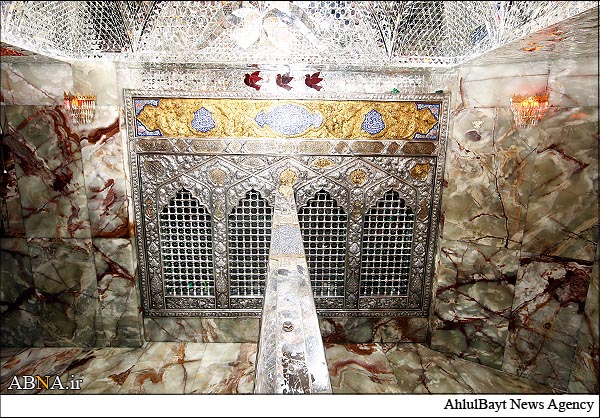
But why would all these people walk for hundreds of miles to remember a painful event that took place over 13 centuries ago? Visitors to the shrine of Hussein and his brother Abbas in Karbala are not driven by emotion alone. They cry because they make a conscious decision to be reminded of the atrocious nature of the loss and, in doing so, they reaffirm their pledge to everything that is virtuous and holy. The first thing that pilgrims do on facing his shrine is recite the Ziyara, a sacred text addressing Hussein with due respect for his status, position and lineage. In it, the Shia imams who followed him after the massacre in Karbala instruct their followers to begin the address by calling Hussein the "inheritor" and "heir" of Adam, Noah, Abraham, Moses and Jesus.
There is something profound in making this proclamation. It shows that Hussein's message of truth and freedom is viewed as an inseparable extension of that list of divinely appointed prophets. Pilgrims go to Karbala not to admire its physical beauty, or to shop, or to be entertained, or to visit ancient historical sites. They go there to cry. They go to mourn. They go to join the angels in their grief. They enter the sacred shrine weeping and lamenting.
It is as though every person has established a personal relationship with the Imam. They talk to him and call out his name; they grip the cage surrounding his tomb; they kiss the floor leading into the shrine; they touch its walls and doors in the way one touches the face of a long-lost friend. It is a picturesque vista, on epic proportions. What motivates these people is something that requires an understanding of the character and status of Imam Hussein and the spiritual relationship that Shias, and in particular Shia Iraqis, have developed with his living legend.
"Who is this Hussein"? For millions of Shia pilgrims, questions this profound, which can cause a man to relinquish his religion for another, can be answered only when you have marched to the shrine of Hussein for 14 days on foot. The verses of a Shia friend of mine sum it up:
The closer I get and when you I'll be seeing,
My emotions take control, with love I begin to shake.
I look at you now and my life has new meaning.
From you some painful beauty with me I must take.
O Karbala, I feel what you're feeling,
O land of loving sorrow, O land of heartbreak,
O land where my leader does rest,
Welcome me as a pilgrim, please make me your guest.
By Sayed Mahdi Al-Modaressi (A Shia cleric and chief executive of Ahlulbayt Television Network)