Showing posts with label Makka. Show all posts

Sunday, June 12, 2011

Location of Ghadir Khumm

Ghadir Khumm is located between Makkah and Madinah in the vicinity of al-Juhfah.   It was the place where pilgims (hujjaj) from different provinces would part company and take different routes for their respective homes.
The nature of the land along the coastal line of the Red Sea.


A sketch of the path taken the Prophet (PBUH) in his historic Hijrah.


 Al-Ghadir spring that might be the historic spring that was cited in history books in the context of the Farewell Pilgrimage (Hajjat al-Wada')


 Palm trees that grew after stoppage of visitors and their eating of dates in the valley.

 Al-Ghadir mountain where waters run and valleys form in seasons of rain.
 

Tuesday, July 13, 2010

Imamat, during the Prophet's (s.a.w.s.) time and after(1)


There is no doubt that no matter how clear and precise divine laws may be, they still need clarification. All nations may have laws in their own languages, yet they require interpreters of these laws.

The Holy Prophet's (s.a.w.s.) prophethood can be divided in two parts - his life in Mecca and his life in Medina. The difficulties of Mecca did not allow the Holy Prophet (s.a.w.s.) enough respite to explain the different laws and commands (ahkam) of Islam. His life in Mecca comprised mostly of discussions based on beliefs (aqaed). When he (s.a.w.s.) migrated to Medina and faced fewer restrictions there, he started explaining (in detail) the Islamic commands and law. Although in Medina there was no persecution as in Mecca, but persistent battles with the disbelievers occupied his time. Probably this is the reason we find various methods employed by the Holy Prophet (s.a.w.s.) in the explanations of Islamic laws. Therefore it is necessary for a Muslim to have comprehensive knowledge of Islamic laws and commands if he wishes to follow Islam correctly.

Some Muslims claim that after the Messenger of Allah (s.a.w.s.), the common Muslims are enough for the clarification of laws (i.e. the Muslims themselves can clarify the laws and do not need any other medium). The following incident shows how false this perception is. A person at the time of Umar complained to him 'I have not been married for more than six months and my wife has already given birth to a child.' The judge heard the case and ordered the woman to be stoned to death. On the way, the woman saw Ameerul Mo'mineen - Hazrat Ali (a.s.) and beseeched him to rescue her. Hazrat Ali (a.s.) after hearing the entire incident sent the executioners back and asked the Caliph - 'What kind of a judgment is this?' The Caliph said, 'It is not more than 6 months and she has already given birth to a child. This clearly means that she has committed adultery.' Hazrat Ali (a.s.) replied, "Has the Quran not revealed:'and her terms of pregnancy and suckling is 30 months.'

The Caliph replied 'Yes, I have read this verse.' Hazrat Ali (a.s.) said that another Quranic verse (Baqarah: 232) points out, 'Mothers should suckle their children for a complete 2 years.'

'Yes I have read this verse too.' Ameerul Mo'mineen (a.s.) then explained, 'If we subtract 24 months from a total of 30 months, 6 months remain. If suckling period is 24 months, then the minimum period of pregnancy invariably is the remaining 6 months. So a woman cannot be liable for punishment if she delivers a child within that period.'

It is indeed noteworthy that if this was the case with the people that they could not discern the divine command when it was clearly mentioned in the Quran, then what about those laws, which were not clearly specified?? And if this is the situation with the Caliph of the Muslims, then what about the common man??

Saturday, July 10, 2010

Reward of Hajj and Umrah - 2

Imam Ja'far Sadiq (a.s.) says,

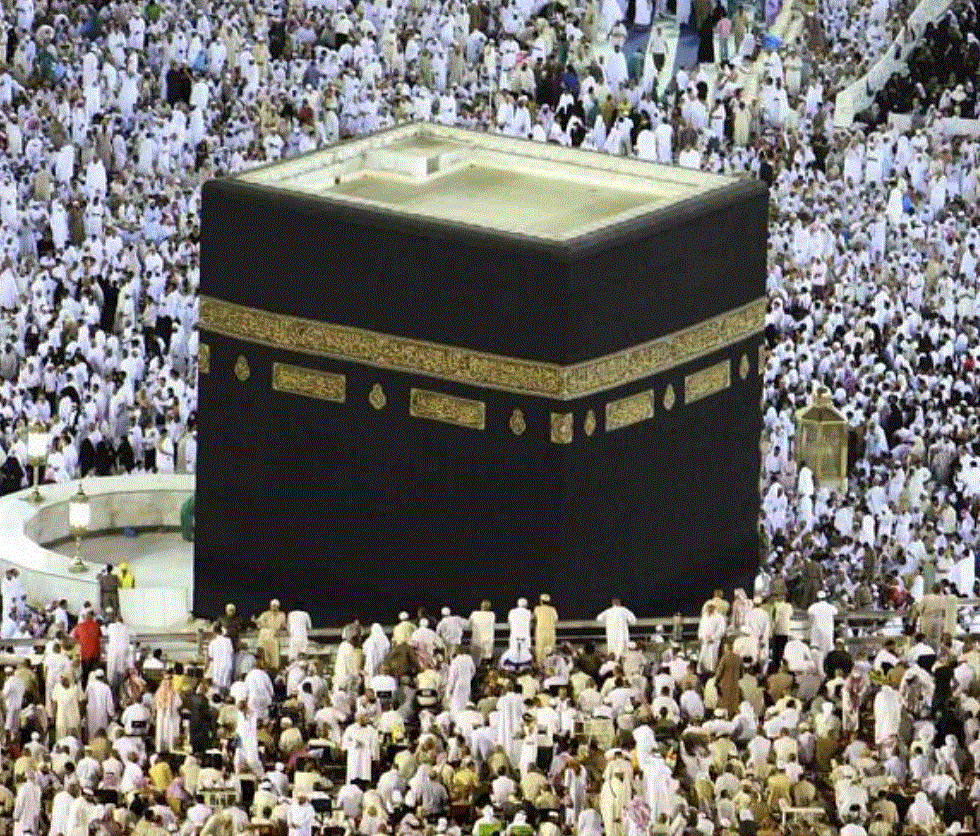
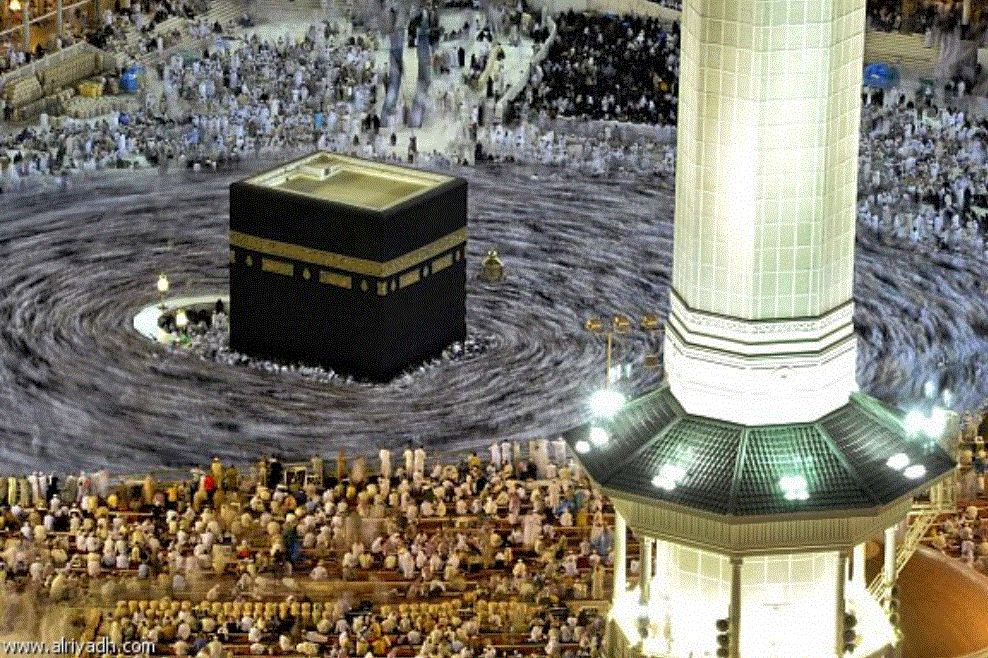
"Allah, the Blessed and the High, has positioned one hundred twenty bounties around Mecca. Out of that sixty are for those who perform circumambulation, forty for those who offer Salaat and twenty for the spectators."

A person came to Imam Musa Kazim (a.s.). Imam (a.s.) asked him, "Are you returning from Hajj?"
"Yes," he replied.
Imam (a.s.) asked, "Do you know the reward of a Hajj pilgrim?"
He replied, "May I be sacrificed for you, I don't know."
Imam (a.s.) said,

"Every pilgrim should enter Mecca for Hajj with extreme humility. When he enters Masjidul Haraam, he should
take small steps out of the fear of Allah. He should perform circumambulation of the Holy Kaaba and offer two rakat Salaat. Allah, the Mighty and Sublime would note seventy thousand rewards for him, wipe his seventy thousand sins, increase his position seventy thousand levels, fulfill his seventy thousand wishes and grant him the reward of freeing seventy thousand slaves each costing ten thousand dirhams."

Reference:

  • Sawabul Aamaal (English - Printed by As-Serat Publications),  Pg 79, Hadees 11,12

Reward of Hajj and Umrah

Imam Ja'far Sadiq (a.s.) said that when the Holy Prophet (s.a.w.s.) started moving towards Arafah, a Bedouin saw him in the desert and said, "O Messenger of Allah (s.a.w.s.)! I have come to perform Hajj but I am not able to do so because of some problem. I have wealth; tell me something, which I can do and gain the reward of performing Hajj."

The Holy Prophet (s.a.w.s.) pointed at Mount Abu Qubais and replied,

"If you have a quantity of red gold equal to Mount Abu Qubais and you spend it in the way of Allah then too you won't get the reward of Hajj."

Imam Ja'far Sadiq (a.s.) says,

"The people who return from Hajj are of three types – some are freed from the fire of Hell, some become pure of their sins like they were on the day their mothers gave them birth and some protect their family and wealth. These are minimum benefits for a Hajj pilgrim."

Reference:

  • Sawabul Aamaal (English - Printed by As-Serat Publications),  Pg 77, Hadees 8,9